
Powder Coat Paint: From Resin to Finish
Powder coating feels like magic: a dry powder turns into a hard, flawless skin on metal parts that resists chips, weather and time. But behind that glossy—or textured—finish is a tidy, mechanical-chemical choreography that blends chemistry, heat and good engineering. Whether you’re a curious buyer, a shop owner, or someone planning a manufacturing line, here’s an engaging tour of the powder coat manufacturing and finishing process — step by step.
The big picture — two linked processes
Think of powder coating as two linked workflows: (A) making the powder (the raw coating material) and (B) applying and curing the powder onto parts. The powder-making side is a small chemical factory (mixing → extruding → flaking → grinding → sieving → packing). The application side is an industrial finishing line (pre-treatment → electrostatic application → curing → cooling & inspection). Together they produce the robust coatings you see on gates, furniture, appliances and industrial gear.
Making the powder — how the raw material is born
-
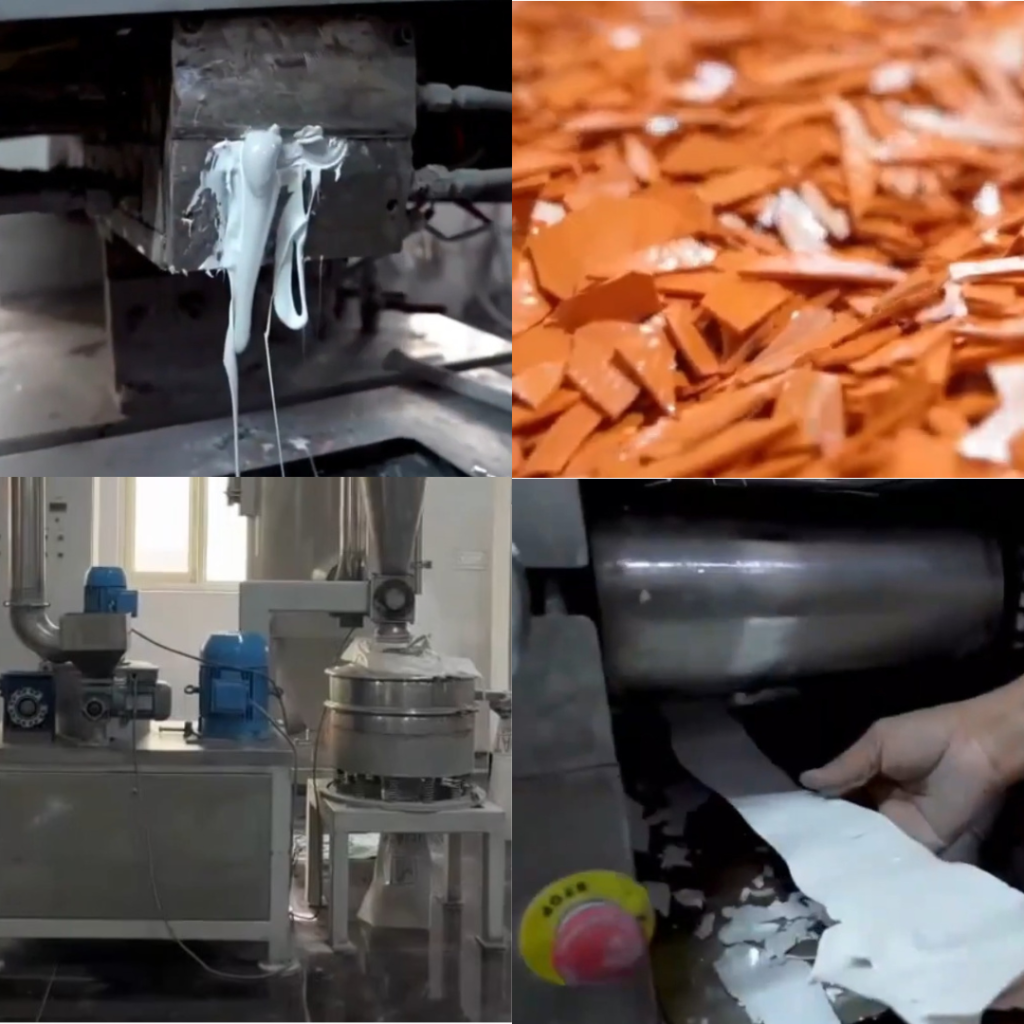
Weighing & Mixing: Precise recipes start with resins (polyester, epoxy, polyurethane or hybrids), pigments, fillers, flow agents and curing agents. Ingredients are weighed, blended and homogenized so color and properties stay consistent.
-
Extrusion: The blended mix is fed into an extruder where heat and shear melt and disperse the components into a uniform molten mass. This step makes the chemistry intimate and reactive in the right way.
-
Cooling & Flaking: The melt exits the extruder as a thin sheet and is quickly cooled. That sheet is then flaked into chips — an easy-to-handle intermediate.
-
Grinding & Sieving: The flakes are milled to a fine powder and sieved to ensure a tight particle-size distribution (often 20–70 microns). This particle size influences spray behavior, film thickness and finish.
-
Quality Control & Packaging: The powder undergoes tests for melt flow, particle size, color and cure behavior. Once approved, it’s packaged—often in boxes or drums—ready for the applicator.
Why these steps matter: extrusion and subsequent milling lock in the resin-to-additive relationships that determine weather resistance, gloss, flexibility and cure schedule. Different resin systems produce powders tailored for outdoor durability (polyester TGIC or HAA systems), chemical resistance (epoxy) or specialty low-bake/UV-curable powders.
The finishing line — from dirty metal to showroom finish
-
Pre-treatment / Surface preparation: The most common cause of coating failure is a dirty substrate. Parts are degreased, rinsed, and often chemically treated (phosphate or non-chromate alternatives) to remove oils, oxides and to improve adhesion. Good pre-treatment is half the job.
-
Masking & Hanging: Areas that must remain uncoated are masked. Parts are staged on racks or conveyors, electrically grounded so the charged powder will be attracted to them.
-
Electrostatic Application: Using a spray gun, the powder receives an electrical charge and is sprayed toward the grounded part. The electrostatic attraction helps powder “wrap” into corners and adhere uniformly — no drips, no solvent.
-
Curing Oven: Coated parts pass through an oven where the powder first melts, flows out to a smooth film, then chemically cross-links (for thermosets) into a tough polymer network. Typical cure schedules vary (e.g., ~160–200°C for several minutes) depending on chemistry and part mass.
-
Cooling, Inspection & Testing: After cooling, parts are inspected for coverage, thickness, gloss/texture and defects. Sampling tests (adhesion, impact, salt spray for corrosion resistance) verify performance before shipment.
Small details that make a big difference
-
Particle size distribution affects finish uniformity and powder consumption.
-
Flow and degassing agents in the formulation prevent pinholes and help the powder level smoothly.
-
Oven profile & part temperature matter: heavy parts take longer to reach cure temperature and require tuned conveyor speeds.
-
Environment & housekeeping: powder shops must be dust-controlled and avoid contamination to prevent specks or poor adhesion.
Sustainability & trends
Powder coatings are eco-friendly compared to solvent-borne paints because they contain little to no volatile organic compounds (VOCs) and overspray can often be reclaimed. Advances include UV-curable powders (lower energy cure) and TGIC-free chemistries to meet stricter regulations while improving durability.
Hi, this is a comment.
To get started with moderating, editing, and deleting comments, please visit the Comments screen in the dashboard.
Commenter avatars come from Gravatar.